

Scale is the beginning
The hardest data workloads do not simply produce more data.
They demand greater precision, faster decisions, deeper history, and less tolerance for error.
Simultaneously.
Data that cannot be simplified
A waveform in a plant, a full order book, an experimental trace, or a radar return may contain the signal that matters. Downsampling, aggregation, or flattening can remove the answer.
Decisions that cannot wait
Industrial operations, trading systems, experiments, and mission systems must ingest continuously while serving serious analytical workloads. Batch movement and secondary systems introduce delay and complexity.
Results that cannot be wrong
Event order, timestamp precision, corrections, calibration, and conflicting observations can change the conclusion. The infrastructure must preserve enough of the original reality to produce an answer you can trust.
The Quasar Difference
Extreme data.Immediate answers.
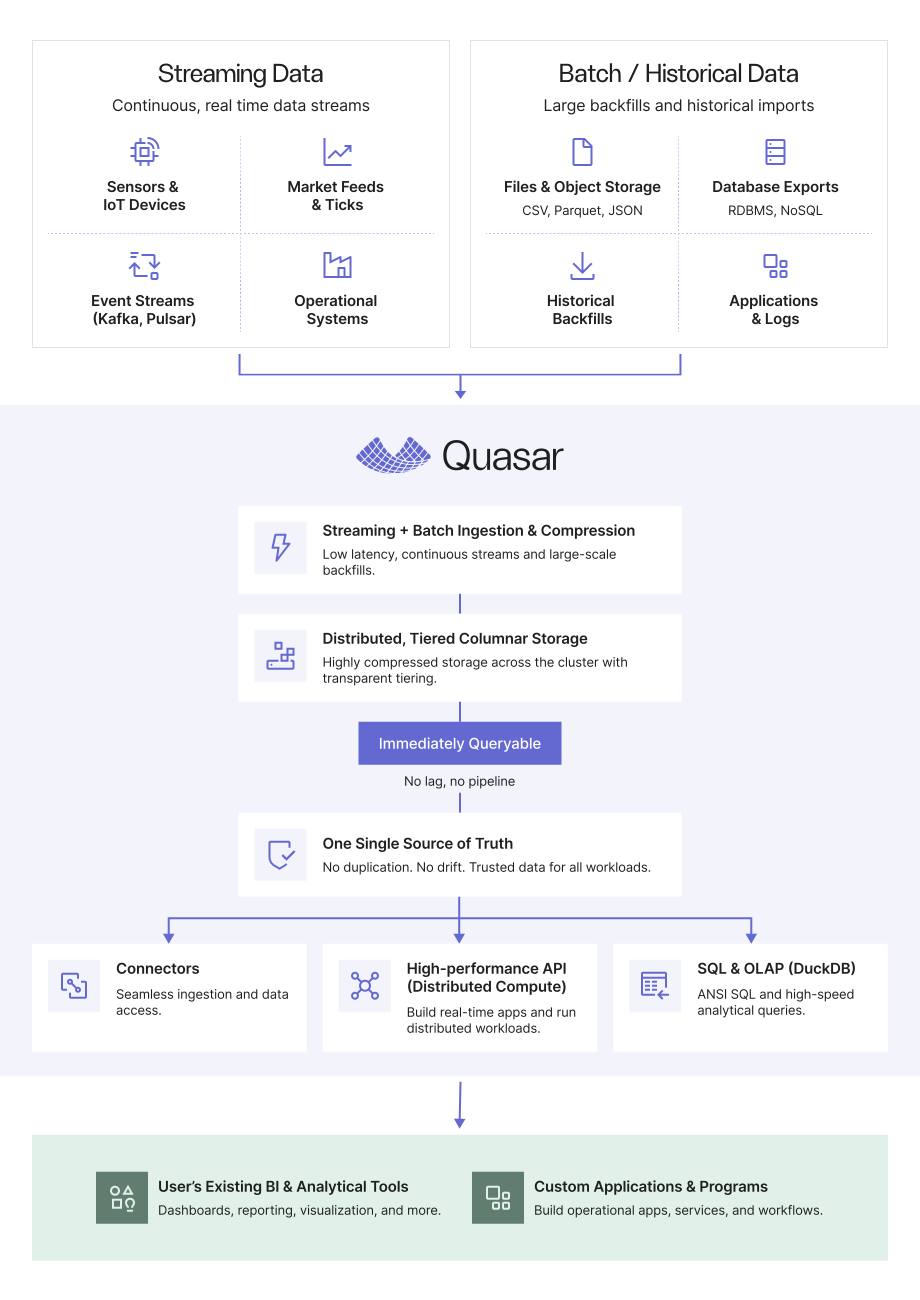
Quasar keeps live ingestion, deep history, and heavy analytics on the same distributed dataset.
New data becomes queryable as it arrives. There is no warehouse loading cycle, refresh window, or delay between ingestion and visibility.
- Immediate visibility keeps operational and analytical views current.
- Adaptive lossless compression keeps deep history economically online.
- Predictable query execution supports heavy analytics while ingestion continues.
- Distributed architecture sustains the workload as data volume and computation grow.
Quasar brings precision, speed, scale, and correctness together instead of forcing you to choose between them.
Where the hardest data problems live
Aerospace
Sensor fusion, imperfect clocks, conflicting observations, and operational history that can be replayed and verified.
Finance
Full-depth market data, exact event ordering, and point-in-time reconstruction at scale.
Industry
Deep operational history, real-time ingestion, and low- and high-frequency signals in one system.
Sciences
High-rate experimental data with precise timing, full fidelity, and complete history.