
Where Quasar Fits
● Where Quasar sits in the stack
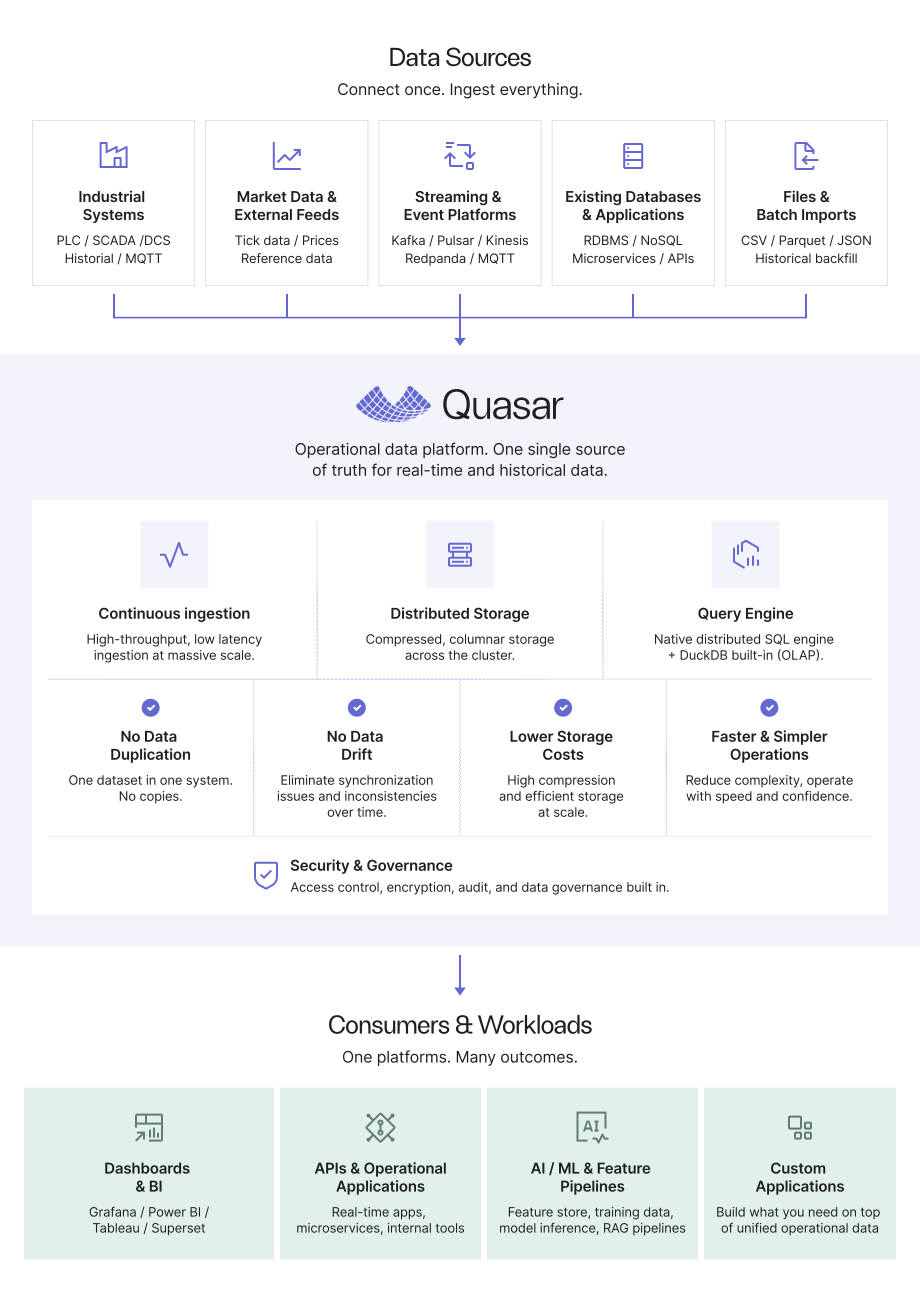
How Quasar fits
Streaming platforms move events. Historians collect operational signals. Data lakes store cheaply. OLAP systems provide broad analytical capabilities.
Quasar becomes the operational convergence layer between these systems for high-volume numerical and time-series workloads.
It continuously ingests streaming and batch data, stores deep history efficiently, and makes the same dataset immediately queryable through native distributed execution, APIs, and OLAP interfaces.
This allows teams to stop stretching streaming systems into databases, historians into analytical platforms, or data lakes into operational stores, while continuing to integrate with existing tools and workflows.
Does Quasar replace existing systems?
Sometimes, but not necessarily.
The most effective deployments usually keep existing systems where they already work well, while moving operational numerical and time-series workloads into Quasar.
For example, teams may continue using their existing OLAP platform for broad analytical workloads while offloading high-volume operational queries to Quasar. Streaming systems can continue distributing events while Quasar handles long-term storage and analytical access. Existing historians can remain in place while Quasar provides deeper historical retention and distributed analytics.
Quasar integrates naturally into existing architectures and can expand gradually over time as workloads evolve.
Operational benefits
- Stop overloading streaming systems with analytical workloads
- Stop stretching historians beyond operational collection
- Keep historical data operational instead of burying it in lakes
- Query real-time and historical data from the same source of truth
● Quasar by system category
Kafka, Kinesis, NATS, and similar systems are designed to move and distribute events at scale.
Quasar integrates directly with streaming systems, allowing them to remain focused on transport and event distribution while Quasar handles long-term storage, indexing, and analytical access.
This is especially useful when operational data needs to remain queryable long after it leaves the stream.
Historians and TSDBs work well for operational collection, visualization, and local monitoring workloads. Problems usually appear when teams start running large-scale analytical workloads on top of continuously growing operational history.
At that point, architectures often expand with separate OLAP systems, data pipelines, and duplicated datasets to compensate for limited analytical capabilities, introducing additional cost, latency, and synchronization complexity.
Quasar provides a distributed operational database designed for continuous ingestion, deep historical retention, and real-time analytical access on the same underlying dataset.
At the same time, existing historians can remain in place for operational workflows and visualization while Quasar becomes the analytical and historical layer behind them.
Data lakes provide inexpensive large-scale storage and long-term retention, but querying operational data directly from lakes often turns into expensive compute workloads layered on top of raw files.
Quasar keeps large numerical and time-series datasets continuously operational by storing them in a distributed database where data remains immediately queryable through native APIs, distributed execution, and OLAP interfaces.
With Quasar, data lakes return to what they do best: archival storage, raw data retention, backup, and offline processing.
OLAP platforms provide mature SQL ecosystems, BI integrations, and broad analytical tooling. Their flexibility often leads teams to route operational numerical and time-series workloads through systems that were not designed for sustained ingestion, low-latency access, or continuously growing history.
Quasar provides a database designed specifically for these workloads, while also exposing a native OLAP interface powered by DuckDB for full SQL access, dashboards, and analytical workflows.
Teams can query Quasar directly through this built-in OLAP layer, connect Quasar to their existing analytical platform, or combine both approaches depending on the workload.